

What to Know About Kasubi Tombs
The Kasubi Tombs in Kampala, Uganda, serve as burial grounds for four kabakas and other members of the Buganda royal family. This site is significant for the Ganda people spiritually and politically, and it showcases traditional architecture. It was designated a UNESCO World Heritage Site in December 2001 for its unique construction and being the largest grass thatched house in the whole world.
In March 2010, a fire nearly destroyed major buildings, and the cause is still under investigation. In July 2010, the site was listed as a World Heritage Site in Danger. The Buganda Kingdom promised to rebuild the tombs, and the Ugandan government offered help. Reconstruction began in 2013 with funding from Japan, and the site was removed from the “in danger” list in 2023.
The Royal Tombs
The World Heritage Site covers about 26 hectares (80 acres) on Kasubi Hill in Kampala, approximately 5 kilometers northwest of the city center. Most of the site is farmland using traditional methods. It includes a royal palace built in 1882 by Muteesa I, the 30th Kabaka of Buganda, to replace his father’s palace from 1820. After Muteesa I’s death in 1884, the palace became a royal burial ground. This site features the royal tombs of four Kabakas of Buganda, differing from the tradition that usually has one tomb for each king.
The Four Kabakas of Buganda Resting at Kasubi Tombs
- Muteesa I (1835–1884)
- Mwanga II (1867–1903)
- Daudi Chwa II (1896–1939)
- Sir Edward Muteesa II (1924–1969)
According to the traditions, the descendants of the four Kabakas are buried elsewhere on the site.
The ceremonial site on Kasubi Hill, established in 1882, is marked by bark cloth trees that protect it from nearby residential development. The main area is in the northwest, featuring a gatehouse (Bujjabukula) that leads to a courtyard and a drum house (Ndoga-Obukaba) for royal drums and to a main circular courtyard (Olugya) on the hilltop, surrounded by a reed fence.
The internal structure of the Kasubi Tombs
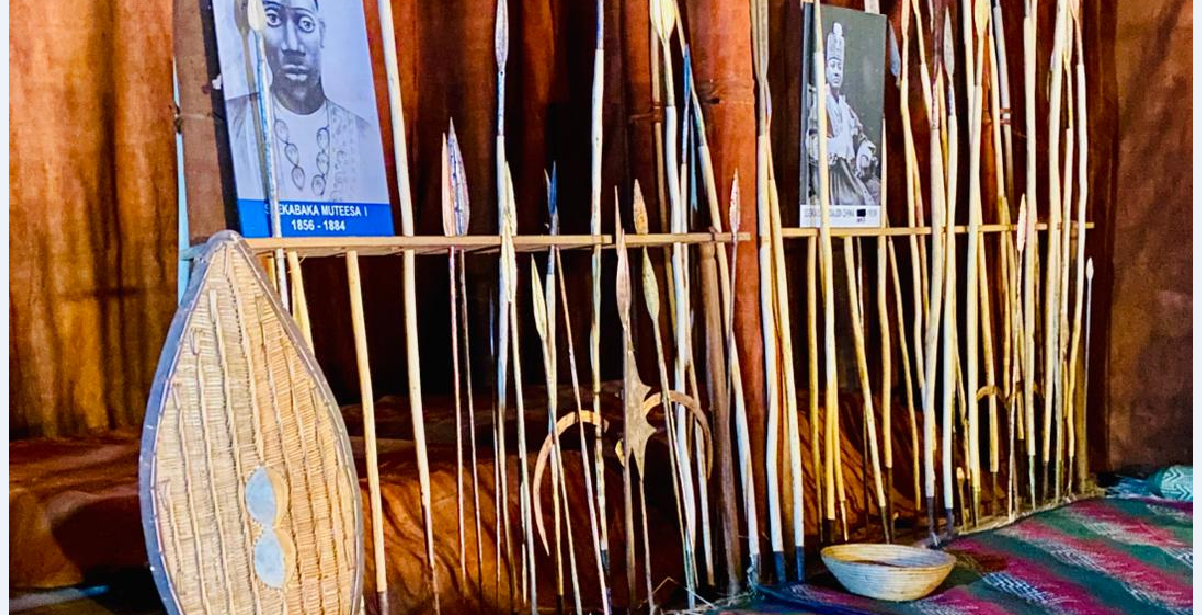
The main building, Muzibu Azaala Mpanga, is 31 meters in circumference and 9.5 meters high, located at the opposite end of the courtyard from the entrance. It was originally made of wooden poles and thatch, representing the 52 clans of the Baganda people. In 1938, King Mutesa II renovated it using modern materials like steel and bricks, which are mostly hidden. An arch leads to sacred areas that are separated by reed partitions, decorated with bark cloth and kabakas’ mementos. The tombs are set in a sacred forest, hidden behind a bark cloth curtain, with a floor of lemongrass and palm mats.
The building was managed by the Buganda Kingdom until it was abolished in 1966 by Prime Minister Milton Obote and reinstated in 1993 by H.E Yoweri K Museveni , the current president of Uganda. It was protected under Ugandan law in 1972 and is registered in the name of the Kabaka. The site is significant for the Baganda people and was declared a UNESCO World Heritage Site in 2001.
Destruction of the Main Building
The Muzibu Azaala Mpanga in 2007 housed relics and portraits of the kabakas and was located in a large courtyard. On 16 March 2010, the Kasubi tombs were destroyed by fire at 8:30 pm, with the cause still unknown. The Buganda kingdom plans to conduct independent investigations alongside the national police force.
John Bosco Walusimbi, the then Prime Minister of the Buganda kingdom, announced on 17 March that the kingdom is mourning due to a significant loss caused by a cruel act. He noted that the remains of the kabakas are safe, as the tombs’ inner sanctum was protected. On the same day, Kabaka Ronald Muwenda Mutebi II and President Yoweri Museveni visited the site, where many people gathered to help recover any remains.
Riots erupted during the president’s visit, resulting in the deaths of two or three rioters and injuring five others. Ugandan soldiers and police clashed with rioters in Kampala, using tear gas to disperse a crowd from the Baganda ethnic group. These events unfolded amid tension between the Ugandan government and the Buganda kingdom, following similar riots in September 2009. The king of Buganda was barred from touring his kingdom, and some supportive journalists were arrested and await trial.
Reconstruction of the Main Building
The Buganda Kingdom administration spearheaded plans to rebuild the tombs, with President Museveni promising national government support. A commission was established to investigate the fire and civilian deaths, delivering its report to the Ugandan government in March 2011, which was not made public by April 2012. By December 2012, a restoration plan for the Kasubi tombs was initiated with foreign aid. The Buganda government is focusing on security measures to limit access during the restoration.
A mission was sent by UNESCO to create a prevention plan for reconstructing the tombs after an incident. Based on its findings, the Japanese government chose to fund the reconstruction, remove the tombs from the List of World Heritage in Danger, establish a risk prevention scheme, and send restoration experts.
How to buy tickets at Kasubi royal tombs
The kasubi royal tombs is currently open to the public and tourists can now access the main house – Muzibu Azaala mpanga. The tickets to the royal tombs can be accessed at the site in the office. upon arrival visitors are welcomed and led to the ticket office by the security personnel after registering their credentials. A ticket for foreigners goes for 20 dollars, foreign
residents for 15 dollars while 5 dollars for African visitors. For cultural enthusiasts, Kasubi Royal Tombs is a number one spot for you. kindly book with Ganda Cultural Expeditions for the best cultural experience.


![The Ultimate guide to Uganda’s street food scene [A taste of Kampala]](https://gandaculturalexpeditions.com/wp-content/uploads/2026/03/The-Ultimate-guide-to-Ugandas-street-food-scene-A-taste-of-Kampala.png)