Buganda’s Kings Buried at Kasubi Tombs
Historically, Buganda originally known as Muwawa was among the most powerful kingdoms not only in Uganda but entirely in Africa before the coming of Europeans. Buganda Kingdom with its rich history, it is one of the many kingdoms in Africa that first got civilized, dating way back to the early 13th Century. The Baganda people belong to the Bantu speaking group which spread across Southern Africa.
Historically, legend reveal that the first King of Buganda was Kintu, whose wife was Nambi. Nambi was handed over to Kintu after impressing Nambi’s father Ggulu-the god of the sky with great deeds. History has it that Kintu did not die but instead disappeared into the Magonga forest.
After Kintu’s era, numerous Kings ruled Buganda Kingdom for a couple of years. Unfortunately, a clear description of their information especially the actual dates about their time is not well known. Unlike other Kings of Buganda, it was only during the reign of Kabaka Suuna II between 1836 – 1856 whose correct dates where recorded.
Traditionally, the Kings of Buganda commonly preferred having their palaces constructed on top of major hills throughout the entire Kingdom. This was done mainly due to political reasons as away of strengthening their security especially during the constant attacks from their enemies.
Mores still, this aimed at having a clear view of their colony, spot approaching enemies and curb any internal rebellions. After these kings passing away, the tradition was to bury their bodies in one shrine and the Jawbone in another site. Traditionally, it is still believed that the departed King’s jawbone contained their spirit.
Like any other African tribe, the Baganda believe that once someone dies, his or her spirit remains, and the departed Kabaka would communicate to his successors through a spirit medium. More still, when the Kabaka or a family member dies, an heir or successor is chosen immediately after burial. Several traditions and rituals are performed to appease the spirits of the deceased Kabakas including exchanging presents, sacrificing animals among others.
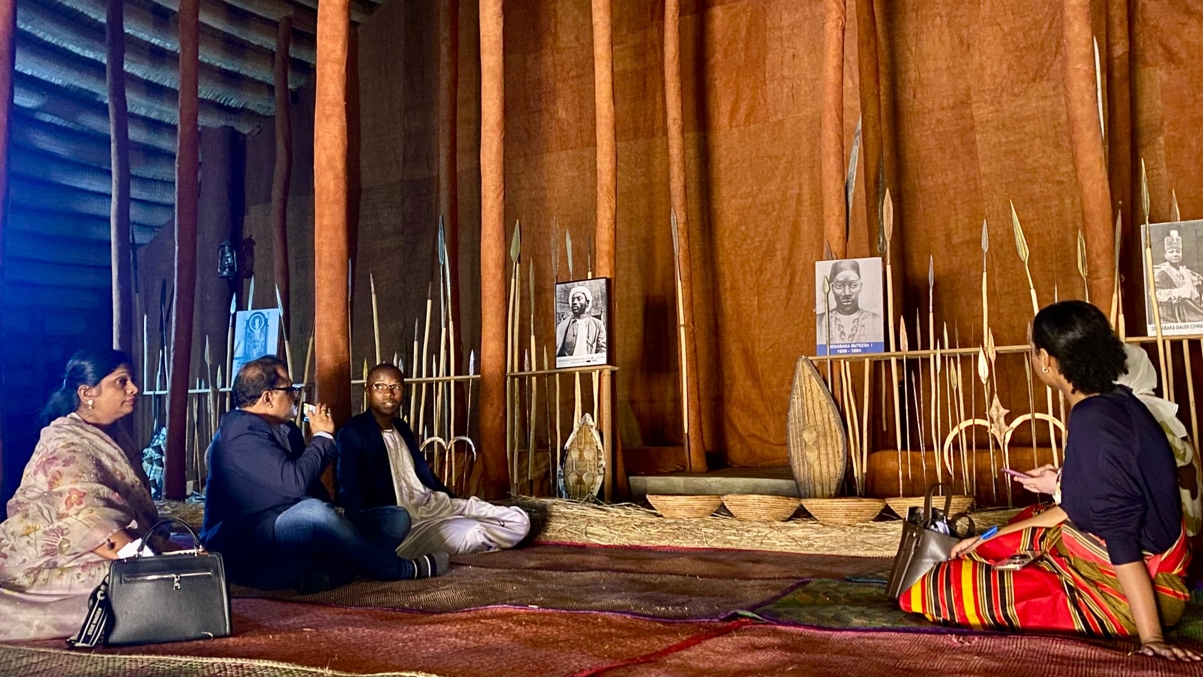
Buganda’s four kings buried at the Kasubi tombs:
Muteesa 1 (1835-1884)
Mutesa I between 1835 to 1884, he was born around 1835 and became King in 1856. Mutesa 1 became the 30th Kabaka of Buganda and his body was the first to be buried in the Kasubi royal tombs. He established his palace in 1882 on Nabulagala Hill and named it Kasubi. This kabaka stayed here for only two years and later passed away in 1884 and his order was to be buried in his own house which later became the major burial ground for other kings that followed after him. He was one of the most powerful kings with several wives than his predecessors.
After realising that his brothers were threat his rule, he instead imprisoned them in a large trench, were most of them got suffocated and died, living him unchallenged. The reign of King Muteesa 1 happened at a time when foreigners had started penetrating Africa in big numbers especially in the eastern part of the continent. As a result, Mutesa 1 became the first king to be influenced by foreign cultures.
After getting into contact and interacting with the Arabs who had come from the East African Coast, searching for ivory and slaves, he turned to the Muslim faith. Since Mutesa 1 picked interest in these Europeans, further hosted John Speke and James Grant-the first white explorers to Buganda in 1862 and Henry Morton Stanley in 1875. During this time, scramble and for Africa was setting pace.
This ignited Muteesa 1 and allowed his Christian and Muslim friends to change his royal staff on condition that they never threatened his authority. In 1884, Mutesa 1 died and was laid to rest at the Kasubi tombs. However, before his death, he told his subjects not to remove his jaw bone for a separate burial. In so doing, he became the first king to deviate from an ancient custom.
Basamula Mwanga II (1867 -1903)
After the death of King Muteesa 1 in 1884, he was succeeded by his son Mwanga Basamula Ekeere 11. This was the last King (Kabaka) to rule a truly independent Buganda. Mwanga’s reign became heavy when the influence of foreigners had grown rapidly. He looked at the new religions of Christianity, Islam and other foreign religions as a serious threat to his rule.
This forced Mwanga 11 to kill many Christians and Muslims popularly known as the Uganda Martyrs, who had changed during his father’s regime in 1886. After these brutal and massive killings of the Uganda Martyrs, Mwanga’s Muslim and Christian chiefs got concerned and joined forces to over throw him.
This pressure forced Mwanga into exile where he joined forces with Omukama Kabalega of Bunyoro to resist the British invasion and get back to the throne. His attempts did not succeed and eventually Mwanga disappeared in exile at the Seychelles island in 1903.
By the time of his death while at the Island he had converted into a Christian and been named Daniel. Later, his remains where repatriated in 1910 and buried at the Kasubi royal tombs. Mwanga 11’s burial at the tombs once again broke with the ancient customs and turned the place into and important burial ground for future kings.
Kabaka Daudi Chwa II (1896–1939)
After the death of Kabaka Mwanga 11, he was replaced by his one-year-old son Daudi Chwa in 1897. Daudi Chwa was assisted by the Christian regents till the age of 18. However, his reign was modest compared to the previous kings of Buganda. He’s known to be a vry progressive king because during his reign, so many tradition changed including women started eating chicken and eggs, he also promoted girl-child education, he formed a federation that takes football in Uganda known as FUFA in 1924, he was the first kabaka to have a holy church marriage because he chose to marry on one wife unlike other kings that had several wives. In 1939, Kabaka Daudi Chwa died, and was laid to rest at Kasubi Royal tombs, this portrayed a significance symbol of strength and reputation both spiritually and culturally.
Fredrick Walugembe Muteesa II (1924–1969)
After the reign Kabaka Daudi Chwa 11, he was succeeded by his son Mutesa the second. During his reign, a serious conflict emerged between Muteesa ll and Sir Andrew Cohen over the 1900 Buganda Agreement. This this agreement led to Muteesa’s exile in England with the representative of the colonial government.
In 1955 the king returned from exile, the king led struggles for Uganda’s independence and he became the first constitutional president of Uganda in 1962. Tension ignited between Muteesa and by then the Prime minister Dr. Milton Obote, leading to the serious attack on his palace by the government troops in 1966 led by the army commander Idi Amin under the orders of the prime minister Dr. Milton Obote. Fortunately, the King was able to escape and fled to England where he found exile. The prime minister declared himself the president of Uganda and took over the king’s palace, Obote went ahead and abolished all the kingdoms in Uganda up to 1993 when the current president reinstated these kingdoms.
While kabaka Muteesa ll was in exile celebrating his birthday, he was poisoned and passed away in 1969. In 1971, Mutesa 11’s remains were transferred back by Idi Amin and buried at Kasubi Royal Tombs where his fathers were buried. Dear visitors thus this site becomes a very significant site to Buganda kingdom therefore becomes a MUST visit during your stay. Kindly book with Ganda Cultural Expeditions for the best experience.