Uganda’s Culture
Uganda’s culture consists of many ethnic groups. The Bantu-speaking people, who are prevalent in East, Central, and Southern Africa, include the Baganda, the largest ethnic group in Uganda. They mainly inhabit the central region, previously known as Buganda Province, across several districts such as Kampala, Wakiso, Luwero, Kiboga, Butambala, Buikwe, Mpigi, and Masaka. Their language is Luganda.
The Lango and Acholi peoples mostly live in the north and speak Nilotic languages. In the east, the Iteso and Karamojong also speak a Nilotic language. The Gishu, a Bantu group, live on Mt. Elgon and speak Lumasaba. A few Pygmies are found in western Uganda’s rainforests.
Languages of Uganda
Uganda has a rich mix of cultures and uses about 57 languages. The most common language is Luganda, while English and Swahili are the official languages. English is more favored, and although Swahili became official in 2005, it is not widely spoken like Luganda. Education is mainly in English.
Traditional culture
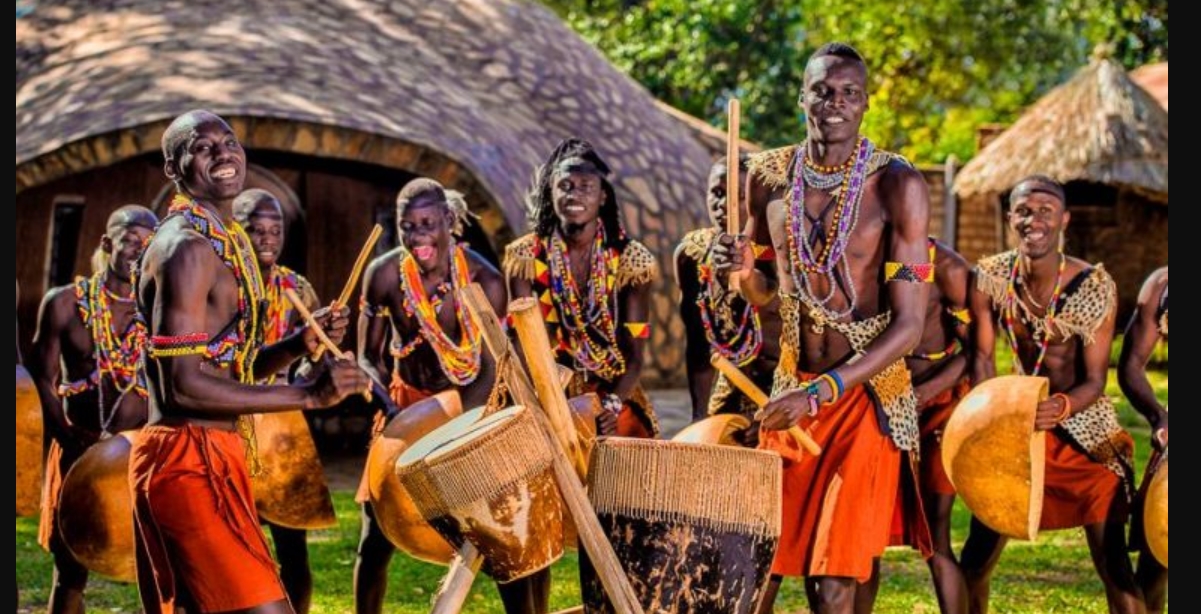
Ugandan customs and traditions comprise foods, folk music, dances, dressing, and building styles, among others. In Northern Uganda’s Lango sub-region, the child-cleansing ceremony is a healing ritual aimed at restoring a child’s lost manhood.
The child and mother spend three days in a grass-thatched house, during which they drink sweetened millet porridge. After three days, they sit at the entrance with paternal brothers. The Acholi and Lango people also have unique dances like Larakaraka and Bwola for Acholi and Okeme/Abuda for Lango.
In Western Uganda, the Empaako naming system helps communities like the Batooro, Batagwenda, Banyoro, and others choose traditional names based on seasons and clans. Traditional dances performed by some of these tribes include Entogoro and Ekitagururo.
Eastern Uganda features traditional practices like the Imbalu circumcision ceremony by the Gisu and Karamoja herders who seek water and pasture. On the other hand, Central Uganda is famous for traditional dances like Nankasa, Bakisimba, and Muwogola, reflecting daily life.
Sport
Like other countries, football is Uganda’s national sport, with the national team called “The Cranes,” managed by the Federation of Uganda Football Associations and this formed in 1924 by Kabaka Daudi Chwa11. They have not qualified for the FIFA World Cup, and their best African Cup of Nations finish was second in 1978. Uganda also qualified for the Cricket World Cup in 1975 as part of the East Africa team.
Uganda has a national basketball league with professional players, college students, and some high school students. The national team, known as the Silverbacks, recently won a regional tournament. Rugby union is also rising in popularity, with the national team gaining strength and achieving more victories.
Uganda has had great success in athletics and boxing at multi-sport events. The country has won seven Olympic medals and 39 Commonwealth Games medals, all in these sports. Notable athletes include John Akii-Bua, who won Uganda’s first Olympic gold in the 400-meter hurdles in 1972, and Davis Kamoga, a bronze medalist in the 400 meters.
Moses Ndiema Kipsiro won a bronze medal in the 5,000 meters at the 2007 World Championships. Stephen Kiprotich won the marathon at the 2012 London Olympics and the 2013 World Championships. Dorcus Inzikuru was the first Ugandan woman to win gold at the World Championships in the 3,000-meter steeplechase in 2005.
Sportsmen like Ayub Kalule were successful Ugandan boxers, winning gold medals at the 1974 World Amateur Boxing Championships and the Commonwealth Games before becoming the World Boxing Association light-middleweight champion in 1979. As of April 2021, Uganda is one of four African members of the International Lacrosse Federation and will have a national team at the 2022 Under-19 World Lacrosse Championships.
Religion
Uganda is one of those countries with diverse religious denominations, and these include Christians, Muslims, and traditions. Christians constitute 85.2 percent of Uganda’s population. Many Sikhs and Hindus left in 1972 due to Idi Amin’s actions but are now returning after President Yoweri Museveni’s invitation. Muslims represent 12 percent of the population.
Dressing and Fashion
In Uganda, the kanzu is the national attire for men. Women in central and eastern Uganda wear a gomesi, a dress with a sash and pointed shoulders. In the west and northwest, they wear a suuka, while those in the southwest wear an omushanana. Women also wear a busuti, introduced by missionaries in the 19th century..